
Stellate Ganglion Block: Treatment for Long Covid
Medically reviewed by Dr. Robert Groysman, MD, Diplomate of the American Board of Anesthesiology and the American Board of Pain Medicine | Updated July 2026
Quick answer: A stellate ganglion block is an injection of local anesthetic placed next to a cluster of sympathetic nerves in the front of the neck, using ultrasound to guide the needle. For Long COVID it is used off-label, with the goal of quieting a sympathetic nervous system that has been stuck in overdrive since the infection. A 2026 systematic review of seven studies found response rates between 55.8% and 100%, with the strongest results for cough, shortness of breath, headache, joint pain and pins-and-needles sensations. None of those seven pooled studies included a control group, so the honest summary is that SGB is promising and not yet proven. Dr. Groysman performs the block under ultrasound guidance in Plano, Texas.
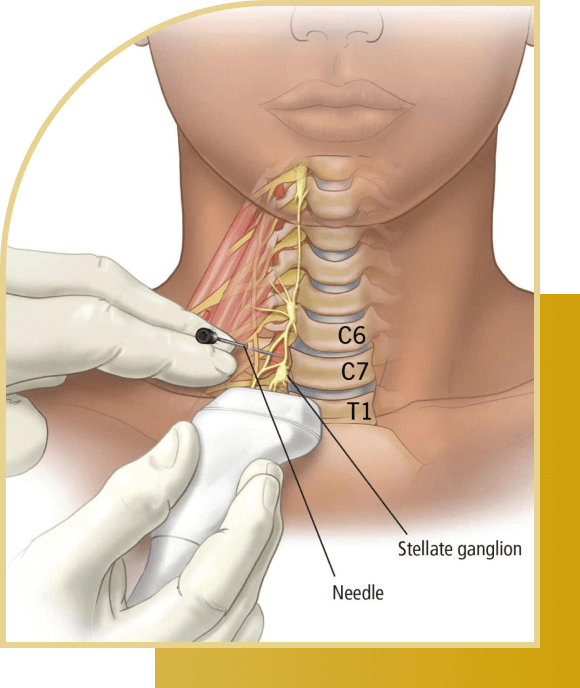
What is a Stellate Ganglion Block?
SGB involves a precise injection of local anesthetic into the stellate ganglion under ultrasound guidance.
The treatment restores the balance between two parts of your nervous system by blocking the overactive sympathetic part in your neck.
This procedure helps to:
- Reduce overactivity in the sympathetic nervous system.
- Restore balance between the sympathetic and parasympathetic systems.
- Alleviate neurological and psychological symptoms caused by Long COVID.
But timing is crucial.
When SGB is delayed (in people with other long-lasting post-viral conditions like Lyme disease or chronic fatigue syndrome), it doesn’t work as well compared to those with long COVID-19.
They only see a small improvement, about 10-20%, with each injection.
Contact us to discover how SGB might help you.
What is a Stellate Ganglion?
The stellate ganglion is a collection or cluster of nerves, known as the stellate ganglion, that lives on the front of our spines in our neck.
It is responsible for some of the automatic or autonomic responses that your body does such as the fight or flight response, dilating your pupils, increasing your heart rate, and so on. They relay the signal from your spinal cord to your brain and from your brain to your spinal cord.
What Symptoms Can SGB Help?
It is worth being specific about who this does not help.
If your main complaint is loss of smell or taste, the evidence is genuinely mixed: one case series reported improvement in five of six patients, while the larger 2024 chart review found no response in some people and attributed it to structural damage.
Long COVID affects an estimated 10 to 30% of people who are infected, and it is not one condition. A block that quiets an overactive sympathetic system helps the people whose symptoms are driven by that system, and it will not do much for the ones whose are not.
Sorting out which group you are in is the point of the consultation.
Patients have reported improvement in:
- Brain fog
- Chronic fatigue
- Anxiety and PTSD
- Taste and smell issues
- Sleep disturbances including insomnia
- Chest pain and palpitations
- Neuropathy in arms and hands
- Dizziness and lightheadedness
How is Dr. Groysman's SGB different from a standard block?
A standard SGB is a single injection at C6 or C7, usually with a steroid or anesthetic for pain.
Dr. Groysman’s technique is ultrasound guided, performed at two levels (C6 and C4), uses a local anesthetic and aimed at freeing the vagus nerve. The two-level approach has been linked to better recovery.
Personalized Care with Dr. Groysman
At Covid Institute, we understand that no two patients experience Long COVID in the same way. Dr. Groysman will develop a personalized treatment plan tailored to your unique symptoms and needs. This may include:
- Stellate Ganglion Block as a foundational therapy.
- Complementary treatments such as vagus nerve stimulation or nutritional support.
- A regimen of supplements and prescription medications to optimize recovery.
What to Expect From Us
1: Initial Consultation: A thorough assessment of your symptoms, medical history, and your side of the story.
2: Custom Treatment Plan: Based on our finding we’ll create a personalized recovery roadmap customized to your body’s needs.
3: Procedure Day: We’ll prep you and help make you as feel as comfortable as possible to help settle your nerves. During the procedure, you’ll receive an Ultrasound-guided injections. Performed in-office, with most procedures completed in under 10 minutes.
4: Follow-Up: Ongoing monitoring and adjustments to ensure optimal recovery.
“For those considering an SGB, I wanted to give you an update of the one I had with Dr. Groysman this past Thursday. First, off Dr. Groysman, Hailey, Chris and Dawn are top-notch. Everyone is so nice and helpful that I felt at ease and comfortable with the procedure.” – P.C.

What does getting an SGB feel like?
Most patients feel only mild, brief discomfort during an SGB. You feel pressure from the ultrasound probe on your neck, then a short pinch and maybe a few seconds of burning as the anesthetic goes in.
The area then turns numb. Most people return to normal activities the same day.
How long does a stellate ganglion block last?
The numbing from a stellate ganglion block lasts only a few hours, but the changes it triggers can last far longer. Most people see lasting relief. Some return to their old symptoms after days or weeks, most often after stress, a new illness or surgery. Repeat blocks are sometimes needed.
What are the risks of an SGB?
Serious complications are rare. Risks reported in the medical literature include bleeding, infection, nerve injury, seizure, collapsed lung and injury to nearby structures.
Three effects are common, expected and temporary, and it helps to know them in advance so they do not alarm you.
Your eyelid on the injected side may droop and the pupil may look smaller. This is called Horner’s syndrome. It is not a complication. It is the sign the anesthetic reached the nerves it was aimed at, and it wears off with the block.
Your hand and arm on that side may feel warm. That warmth is the sympathetic block taking effect and letting the blood vessels open.
Your voice may sound hoarse for a few hours, or your throat may feel like something is sitting in it. The nerve that serves the voice box runs close to the injection site and picks up some of the anesthetic.
Ultrasound guidance is what keeps the needle away from the structures that matter, which is why the block should not be done without it.
What Does the Procedure Look Like?
You sit or lie back with your head turned slightly away from the side being treated. Dr. Groysman cleans the skin, places the ultrasound probe on the front of your neck and finds the stellate ganglion on screen before anything else happens.
A small amount of local anesthetic numbs the skin. The block needle then follows the ultrasound image to the nerve cluster, and the anesthetic goes in around it. The injection itself takes a few minutes.
You stay for a short observation period while the effects come on. Most people notice the warmth in the arm and the eyelid change within about ten minutes, and most return to ordinary activity the same day. Someone should drive you home.
Some patients are treated on one side only. Others are treated on the right first and the left at a later visit, which is the sequence used in the published case series on smell and taste.
Patient Success Stories
My husband had the stellate ganglion block done by Dr Groysman on September 3rd and he immediately had his energy back, could sleep even better then before he got long covid, no more horse voice after talking in meetings and he can finally work and travel again like before LC. II can’t thank Dr Groysman enough for giving him his life back. – Jms 9/19/2024
I’m so so happy that Dr Groysman was able to help me out. I saw Dr Groysman last week for SGB and EAT. Everyone at the office was so kind and understanding, Dr Groysman did the SGB so fast and I barely felt anything at all other than the pinch for the numbing. The EAT was really easy too. I took a real nap for the first time in months after it was all done!! I had refreshing sleep at night too, some of the symptoms like brain fog and fatigue came back, maybe traveling and the stress wore me out. – A.J. 10/2024
Our Experience with SGB treatments
These findings are from my own personal observations and have not been peer reviewed. Stellate ganglion block or SGB can correct a lot of the neurological and psychological problems associated with long covid. Please note that its actually correcting the problems with the dysautonomia as opposed to just going after symptoms of long covid. It can help with:
- parosmia/dysgeusia
anosmia/ageusia/ +/- - hyposmia
- brain fog
- chronic fatigue
- exercise intolerance
- chest pain
- neuropathies in arms/hands/shoulders
- anxiety associated with PTSD or long covid
- PTSD
- insomnia
While I have observed that it can help with some of the other long covid symptoms, its not consistent. For instance, I have observed improvement of tinnitus in some as well as neuropathic pain in the legs.
Recovery can be permanent or may not last depending how stuck and resistant your sympathetic nervous system is. It sometimes snaps back to where you were despite it being in an abnormal state, because the body likes equilibrium. Stress or another illness can also cause long covid to show its head again.
How well does SGB work for Long COVID?
The strongest available summary is a 2026 systematic review in Current Pain and Headache Reports. It found seven studies that met inclusion criteria, with response rates ranging from 55.8% to 100%. Relief was reported by more than 80% of patients for cough, shortness of breath, headache, joint pain, pain intensity and pins-and-needles sensations.
A 2026 scoping review in Pain Physician spread wider, pooling 22 articles covering 505 patients, and found the stellate ganglion block to be the most commonly used block of its kind for this condition. The symptoms studied most often were loss of smell, fatigue, headache and cognitive difficulty.
A 2024 retrospective chart review in Autonomic Neuroscience followed patients treated with sequential blocks on both sides. Patients reported reductions in fatigue, worsening after mental or physical effort, memory problems, difficulty concentrating, sleep problems, anxiety and depression.
Here is the part that matters and that most pages leave out. In that same 2024 study, loss of taste and loss of smell did not improve in some people. The authors suggest the damage in those cases is structural, which is a different problem from a nervous system stuck in the wrong setting. A block corrects a signal. It cannot rebuild tissue.
The often quoted figure of 86% comes from a 41-patient study at a single pain practice. That paper received a published correction in 2025 disclosing that all of its authors were employed by the clinic where the procedures were performed. The finding may well be sound, and it is one clinic reporting on its own patients.
Every study above lacked a control group. Sample sizes were small and the designs varied. That is the honest state of the evidence: promising, consistent in direction, and not yet proven. Any doctor who tells you it is proven is ahead of the literature.
Reported improvement by symptom, pooled across seven studies
Figures below are pooled from the 2026 systematic review (reference 1), which assessed seven studies. Read them as what patients reported, not as a prediction for any one person. None of the seven underlying Long COVID studies had a control group.
| Symptom | Patients reporting improvement | Studies |
|---|---|---|
| Pins and needles / numbness | 9 of 9 (100%) | 1 of 7 |
| Joint pain | 15 of 16 (93.8%) | 1 of 7 |
| Dyspnea (shortness of breath) | 15 of 17 (88.2%) | 1 of 7 |
| Subjective overall relief | 22 of 25 (88%) | 2 of 7 |
| Headache | 26 of 32 (81.3%) | 2 of 7 |
| Pain interference and intensity | 13 of 16 (81.3%) | 1 of 7 |
| Cough | 8 of 10 (80%) | 1 of 7 |
| Autonomic dysfunction | 23 of 30 (76.7%) | 4 of 7 |
| Sleep problems | 39 of 54 (72.2%) | 5 of 7 |
| Brain fog and cognitive difficulty | 58 of 81 (71.6%) | 3 of 7 |
| Dizziness | 28 of 40 (70%) | 3 of 7 |
| Fatigue | 74 of 106 (69.8%) | 6 of 7 |
| Depression and mood | 36 of 52 (69.2%) | 4 of 7 |
| Anxiety | 22 of 32 (68.8%) | 4 of 7 |
| Gastrointestinal symptoms | 9 of 14 (64.3%) | 2 of 7 |
| Chest pain | 12 of 20 (60%) | 2 of 7 |
| Post-exertional malaise | 18 of 32 (56.3%) | 3 of 7 |
| Smell and taste changes | 38 of 68 (55.8%) | 4 of 7 |
Two findings in this table did not move at all: morning cortisol levels showed no change, and PTSD scores showed no significant change between before and after. We include them because a table that only lists what improved is a sales sheet, not evidence.
The largest of the seven, a 52-patient cohort at Brigham and Women’s Hospital, adds the detail the pooled numbers cannot show. Only around 14% saw persistent relief, patients averaged roughly three injections, and post-exertional malaise, the crash after activity, barely moved.
What randomized trials show
SGB does have strong randomized evidence behind it, from outside Long COVID. A sham-controlled trial in JAMA Psychiatry, run in active-duty service members, found two stellate ganglion blocks meaningfully reduced PTSD symptoms compared with a sham procedure. This trial is the reason SGB is taken seriously as an autonomic intervention.
For Long COVID, one randomized trial exists so far, and it tested a single symptom: parosmia, the distorted sense of smell. SGB was not superior to placebo there. The result matters. Smell distortion is the symptom the 2024 study above found least likely to respond, possibly because the damage there is structural, and the trial did not test the autonomic symptoms where the uncontrolled studies report the strongest responses.
The fair way to state this is, the mechanism is well established, the procedure has proven in a rigorous trial that it can change autonomic and stress physiology, and the Long COVID application is a reasonable extension of that mechanism, supported by promising but uncontrolled studies, still waiting for a randomized trial of its own on autonomic symptoms.
Take the First Step Toward Recovery
If Long COVID symptoms are holding you back, the Stellate Ganglion Block may be the solution you’ve been searching for. Schedule your consultation today to learn how Dr. Groysman and our team can help you reclaim your health and well-being.
Discover relief. Rediscover you.
Frequently Asked Questions
There are really only a few contraindications to this procedure. If you are taking a blood thinner, it would be best to stop a few days before the procedure if you are able. There is nothing really special that needs to be done beforehand. You do not need to fast. Purchasing a vagus nerve stimulator is helpful after the procedure.
Ultrasound allows for live needle guidance, eliminates all radiation, and soft tissues such as arteries, veins, nerves, thyroid gland, and bone are all visible. Dr. Groysman prefers to see these structures while doing this procedure.
It is a way to interrupt the signals going in and out from the stellate ganglion by numbing the ganglion with a local anesthetic such as lidocaine, ropivacaine, or bupivacaine. This is performed under live ultrasound guidance at least in practice, but it can also be performed with fluoroscopy or live x-ray guidance. This procedure is an injection but it is tolerated very well even awake. We also block the C3 or C4 area which contains the superior cervical plexus and the sympathetic tract or road to the brain. This is not technically part of the actual SGB, but has been shown to improve results by Dr. Eugene Lipov, MD.
Absolutely not. Aside from smell and taste, it has been shown to help with brain fog, fatigue, anxiety, aches and pains, neuropathies, and even tinnitus in some.
It is a group of nerves located on each side of your cervical-thoracic vertebrae (the bones in your neck and chest part of your spine). Signals from the brain stop there before going to the rest of your body. Information for this ganglion is also relayed to the rest of the body including the face, brain, head, neck, arms, and chest. You have one of these on each side of your neck.
It helps to maintain your heart rate and breathing rate even if it’s not in control. It controls your blood pressure. Its main purpose is to protect you from harm and stress, the so-called fight or flight. Best examples are if you almost got run over by a car or being chased by angry bees or dog, perhaps even during and after a heated argument. Its function is to create the best possible conditions to either fight or run. These could include dilating your pupils to allow light to enter the eye, increasing your heart rate and force of heart pumping, dilatating your airways to allow for harder and faster breathing, and supplying more blood flow to muscles of your arms and legs. What does the SNS sacrifice to do all of this? It shunts blood away from your digestive tract so that you won’t be digesting anything. You won’t secrete anything: tears or saliva. You will sweat though.
Your body is meant to have the PNS in the driver seat most of the time. PNS allows your body to heal and take care of maintenance. SNS is like a wrecking ball to our inside, or better yet, a bull in a China shop (although, I can’t think of any time I would want that). It’s great for short term when needed but not 24/7. You are being exposed to epinephrine (adrenaline) and cortisol all day long. You will not only be on edge and have anxiety, but you will also have a difficult time shutting down to go to sleep.
Initially this happens because of direct damage from the covid-19 virus to the supporting cells of the nerves of your nose and tongue, however this tends to heal within a few weeks after recovering from the virus. The smell and taste problems may spontaneously resolve after a few weeks, or they may turn into a lasting effect. The abnormality is fueled by stress and illnesses because both increase sympathetic drive.
There have been many different treatments proposed, but the ones that appear to be most successful and reliably reproduced are the stellate ganglion block and the external ear vagus nerve stimulation. There are many other treatments for other symptoms of long covid.
It is shaped with points similar to a star so it was called a stellate. It is similar to the word stellar.
No, it corrects an abnormal feedback in the autonomic nervous system. It also stops and reduces the inflammation caused by chronic immune activation.
Yes, but not directly. Regular nerve conduction and muscle testing (NCV/EMG) will not show anything about autonomic nervous system (ANS). There are several indirect ways to test the the ANS. Looking at effects on heart rate, blood pressure and sweating is often helpful. Tilt table. Heart Rate Variability (HRV). QSART.
No. It is not a cure and it is not FDA-approved for Long COVID, which means it is used off-label. The published studies report symptom improvement in many patients, with response rates between 55.8% and 100% across seven studies, and none of those studies had a control group. It is a treatment that may reduce symptoms, not one that resolves the condition.
It varies. Published studies have used single blocks and sequential blocks on both sides, and the 2023 case series on smell and taste treated the right side first and the left side at a later visit. Dr. Groysman will discuss a plan based on your symptoms rather than a fixed package.
Possibly, and this is the symptom where the evidence is weakest. A six-patient case series reported improvement in all but one. A larger 2024 chart review found that loss of taste and smell did not respond in some people, and the authors suggest the damage is structural in those cases. Do not choose this treatment on the strength of that symptom alone.
We typically start with a right sided SGB block because most people appear to be right dominant when it comes to which tract is used more frequently. Both blocks can be safely done on the same day.
Let Dr. Groysman and his staff know if you are on blood thinners a few days before the procedure. If you are able to do so, please discontinue platelet blockers and blood thinners such as Eliquis and coumadin. There are no other steps to take before the procedure.
Assuming the SGB was safely performed by an experienced provider such as the ones we perform in our clinic, we expect and want to see the Horner’s syndrome. This is a constellation of signs that show up almost immediately after the block is completed. You may also feel a lump in your throat, hoarseness, loss of voice, or difficulty swallowing for the duration of the effects of the block. This is not caused by the SGB, but by the inadvertent numbing of one of the vocal cord nerves called the recurrent laryngeal nerve. This is not dangerous as long as both sides of your neck are numbed at the same time.
This syndrome is temporary and results from the decreased output of the sympathetic nervous system to your brain, face, head, neck, arms, and chest. It causes a slight droopiness of the eye, redness in the white of the eye, a smaller pupil compared to the unblocked side, a stuffy nose on one side, and flushing of the eye, face, neck, ear, shoulder or arm. The skin in these areas increases in temperature around 1 degree Celsius and appears flushed or red. It is not necessary to see all of these, but I prefer to see at least 3 different signs to indicate that we did a good and solid sympathetic block.
Assuming it was not from lack of technique, it could be because your symptoms are NOT from dysautonomia. There are several other causes of long covid including gut dysbiosis and mitochondrial dysfunction.
No. It is not dangerous and it is temporary when associated with an SGB. We need to see this to verify that you actually received a good SGB and a sympathetic nervous system block. You are not having a stroke or anything like that.
Some smooth muscles that we can’t control voluntarily are controlled by both the parasympathetic and sympathetic nervous system. Others only have one or the other. The droopy upper eyelid or ptosis is caused because we stop the functioning of one of the smooth muscles. The pupil size becomes small under predominantly parasympathetic control when we take away the sympathetic nervous system influence. Similarly, the nostril on the side of the block becomes engorged and swells without the sympathetic nervous system influence.
The heart rate and blood pressure can temporarily increase for 30-60 minutes after a block. Most often symptoms of anxiety, smell and taste tend to respond immediately or within minutes after the block. The other symptoms often take longer to reduce or eliminate and are usually realized by the next day.
Continue the vagus nerve stimulation after the SGB. Try to avoid stressful situations if possible. Try to avoid getting sick or surgery if possible. It takes time for the new state to stabilize and be accepted by your body after being in a heightened sympathetic nervous system state.
We don’t target the symptoms but the actual source of the problem, the dysautonomia. What we have seen respond best to the SGB is smell and taste abnormalities including anosmia (no smell), parosmia (abnormal, and hyposmia, but not phantosmia), brain fog, anxiety, depression, and chronic fatigue.
Some providers talk about the SGB as a reset. What exactly is reset? It is a nerve block. During the duration of the block, the sympathetic nervous system is off on one side. During this time, the parasympathetic tone is elevated and there are regional blood flow changes in your brain, head, neck, and chest. The combination of these things persist after the block wears off.
Because the sympathetic and parasympathetic are on opposite ends of a see-saw, when sympathetic tone decreases, the vagus nerve tone increases.
Aside from the SGB, many of the maneuvers that help improve your vagus nerve tone also calm down your sympathetic response.
The block uses local anesthetic placed around the stellate ganglion under ultrasound guidance. Steroids are not required for this block. Bring this question to your consultation, because practice varies between clinics and you are entitled to know exactly what is going into your neck.
That is Horner’s syndrome and it is expected. A droopy eyelid and a smaller pupil on the treated side confirm the anesthetic reached the nerves it was aimed at. It resolves as the block wears off
Ultrasound guidance is what lets the physician see and avoid the blood vessels and other structures next to the target. This block should be performed with image guidance.
Considering a Practitioner for SGB?
Here are the questions to ask your provider before getting a procedure
I often get asked, “What should I ask my doctor about SGB?”
Below I’ve compiled a list of must-have questions starting with:
- How many SGB’s have you done in the last month?
- Do you do the SGB with fluoroscopy or ultrasound? Ultrasound is technically safer as arteries, veins, nerves are seen and can be avoided.
- Do you do one level or 2 per side (C4 and C6)? Dual level has been shown to increase recoveries.
- Do you do C6 or C7?
- What local anesthetic do you use?
- Do you use a steroid?
- What do you do if I don’t develop a good Horner’s syndrome (red eye, droopy eye, small pupil, stuffy nostril, flushing of face)?
- Can I have it done awake, or do you sedate patients for this procedure?
- Have you had any complications from the SGB in the last year?
- What kind of success have you had doing SGB’s for parosmia/anosmia/brain fog/anxiety?
Note: If you doctor can’t answer or won’t answer these questions, keep looking or come and see us.
To go deeper, read about SGB for POTS after COVID, see what a successful block looks like, or start with the Reddit questions patients actually ask.
Schedule your consultation today
Learn how Dr. Groysman and our team can help you reclaim your health and well-being.
References
The claims on this page are drawn from the peer-reviewed sources below. Where the evidence is weak or mixed, we say so on the page rather than in the footnotes.
- Peddireddy S, VanWingerden N, Patel P, Howard G, Berger J. Stellate Ganglion Block in the Treatment of Long COVID: A Systematic Review. Current Pain and Headache Reports. 2026;30(1). doi:10.1007/s11916-026-01477-5. View study
- Tyagi A, Singh K, Singh PM, Gerges FJ. Sympathetic and Parasympathetic Ganglion Blocks for Treatment of Long COVID-19 Symptoms: A Scoping Review. Pain Physician. 2026;29(3):E151-E161. View study
- Duricka D, Liu L. Reduction of long COVID symptoms after stellate ganglion block: A retrospective chart review study. Autonomic Neuroscience: Basic and Clinical. 2024;254:103195. doi:10.1016/j.autneu.2024.103195. View study
- Pearson L, Maina A, Compratt T, Harden S, Aaroe A, Copas W, Thompson L. Stellate Ganglion Block Relieves Long COVID-19 Symptoms in 86% of Patients: A Retrospective Cohort Study. Cureus. 2023;15(9):e45161. doi:10.7759/cureus.45161. View study
- Pearson L, Maina A, Compratt T, Harden S, Aaroe A, Copas W, Thompson L. Correction: Stellate Ganglion Block Relieves Long COVID-19 Symptoms in 86% of Patients: A Retrospective Cohort Study. Cureus. 2025;17(9):c295. doi:10.7759/cureus.c295. View correction
- Liu LD, Duricka DL. Stellate ganglion block reduces symptoms of Long COVID: A case series. Journal of Neuroimmunology. 2022;362:577784. doi:10.1016/j.jneuroim.2021.577784. View study
- Kalava A, Benyahia SA, Tico Calzada R, Staat CM. Efficacy of Stellate Ganglion Block in Treating Long-Term COVID-19-Related Olfactory and Gustatory Dysfunction: A Case Series. Cureus. 2023;15(6):e40929. doi:10.7759/cureus.40929. View study
- Khan MH, Kirkpatrick KP, Deng Y, Shah KB. Stellate Ganglion Block for Long COVID Symptom Management: A Case Report. Cureus. 2022;14(12):e32295. doi:10.7759/cureus.32295. View study
- Bayramov T. Stellate ganglion block for the treatment of olfactory and gustatory dysfunction in patients with long COVID-19. Agri. 2026;38(2):141-143. doi:10.5606/agri.2026.37. View study
- Chiang MC, Satko KM, Shin C, et al. Stellate Ganglion Block for the Management of Long COVID Symptoms: A Retrospective Cohort Study. Cureus. 2025.
- Farrell NF, Crock LW, Islam A, et al. Stellate Ganglion Block for the Treatment of COVID-19-Induced Parosmia: A Randomized Clinical Trial. JAMA Otolaryngology Head & Neck Surgery. 2025.
- Rae Olmsted KL, et al. Effect of Stellate Ganglion Block Treatment on Posttraumatic Stress Disorder Symptoms: A Randomized Clinical Trial. JAMA Psychiatry. 2020.