
Fasting and Mitophagy in Long COVID
Most fasting advice online is written for healthy people trying to lose weight. If you have Long COVID, you are working with a different body: one already short on energy, already inflamed, already struggling to keep its mitochondria working. Mitochondria are the parts of your cells that turn food and oxygen into usable energy, and in Long COVID they are often damaged. The same fasting protocol that helps a healthy person can leave you flat on your back for three days.
That does not mean fasting has no place in recovery. It means the timing, the length, and the preparation matter more for you than for anyone else.
What happens inside your cells when you fast
When you stop eating for a while, your body shifts out of digestion and into maintenance. It starts clearing out damaged cell parts, burning stored fat, and building new energy-producing machinery.
Two of those maintenance processes matter most in Long COVID:
- Mitophagy. Your cells identify old or damaged mitochondria and break them down so they stop causing harm.
- Mitochondrial biogenesis. Your cells build new, healthier mitochondria to replace what was cleared.
A note on terminology, because it is often reported incorrectly. Autophagy and mitophagy are recycling processes. The cell takes worn-out components apart and reuses the salvageable pieces. This is not apoptosis, programmed cell death, a completely separate mechanism. Your cells are clearing out what no longer works, and building from what they recover.
Alongside the cleanup, fasting lowers insulin levels and shifts cells toward burning fat for fuel. The longer-term metabolic picture is less settled than popular fasting advice suggests, and it is worth knowing before you start. Short-term fasting can temporarily make your body less responsive to insulin while it adjusts, and in human trials much of the metabolic benefit tracks with weight loss rather than with fasting alone.1
Inflammation is not a one-way street either. Fasting is often described as anti-inflammatory, but prolonged fasting has been shown to raise C-reactive protein, an inflammation marker, in human studies.1
What drives Long COVID fatigue is not primarily a metabolic story. It is a mitochondrial one. Mitochondrial damage is well documented in Long COVID, alongside elevated oxidative stress markers and reduced antioxidants such as coenzyme Q10.2 That is the problem this page is about. Whether fasting is the right tool for it depends on the person.
If mitochondrial damage is new to you, start with our overview of mitochondrial dysfunction in Long COVID, which explains where fasting sits inside the wider repair approach.
How long do you have to fast before mitophagy starts?
We do not yet have a precise number for humans.
The figures usually quoted, 16 hours, 18 hours, 24 hours, come largely from animal studies. Translating them to a person is difficult, partly because autophagy is hard to measure in a living body, and partly because the fasting response runs on a different timescale in rodents than in people. A 2025 critical review in Endocrine Reviews makes exactly that point: the difference in timescale between rodent models and humans challenges easy translation of rodent results.1
What we can say is directional. Longer fasts appear to do more cleanup work than shorter ones. Treat any specific hour count as a reasonable working assumption rather than a settled figure.
It is worth keeping in perspective. Fasting to a clock can pull attention away from the signal that matters most: how you feel afterwards.
Mitochondrial biogenesis is thought to respond better when fasting is paired with light exercise or cold exposure, though the strength of that pairing has not been established in Long COVID specifically. In this population it needs care regardless, because exertion can trigger post-exertional symptoms. Read our guidance on post-exertional malaise and pacing before adding any activity to a fasting window.
Common fasting schedules
| Method | Eating window | Fasting period | How often |
|---|---|---|---|
| 16:8 | 8 hours (for example 12pm to 8pm) | 16 hours | Daily or most days |
| 18:6 | 6 hours (for example 1pm to 7pm) | 18 hours | 3 to 7 days per week |
| 5:2 | Normal eating 5 days, roughly 500 to 600 calories on 2 non-consecutive days | 2 days per week | Weekly |
| 24-hour fast | One meal per day, or dinner to dinner | 24 hours | 1 to 2 times per week |
| 48-hour fast | No food, water and electrolytes only | 48 hours | Occasionally, maximum once per month |
Water is not part of the fast
SafetyDo not restrict water. Water has no calories and has no effect on whether a fast works. Restricting it causes dehydration and puts stress on your kidneys for no reason at all.
This matters twice over in Long COVID. Many patients also have dysautonomia, a condition where the nervous system loses reliable control of blood pressure and heart rate. Expert consensus guidance for POTS, the most common form, is to increase intake to roughly 2 to 3 litres of fluid and several grams of sodium daily to support blood volume.6 Any fasting approach that asks you to go without water works directly against that. We do not recommend it.
During a fasting window you can have water, black coffee, herbal tea, and electrolytes.
Why fasting longer than 48 hours works against you
Pushing a fast past 48 hours can produce nutrient deficiencies, muscle breakdown, and electrolyte imbalances. Hormonal stress is another risk, especially for anyone managing adrenal fatigue or a thyroid condition. The repair machinery itself needs nutrients to run, so a fast that goes too long can worsen mitochondrial function instead of improving it. And past 48 hours, incomplete mitophagy becomes more likely, covered in the next section.
Two further risks deserve naming, because they rarely appear in consumer fasting content.
RiskRefeeding syndrome. Coming off an extended fast too quickly can cause a sharp shift of electrolytes into cells, driven by the insulin release following the first real meal. Phosphate, potassium, magnesium, and thiamine can all drop sharply. In serious cases this produces cardiac arrhythmias, respiratory failure, and seizures.4 This is the actual reason to break a long fast gently, and it is why extended fasting belongs under medical supervision rather than self-management.
RiskBone loss. Sustained caloric restriction can reduce bone density at the spine and hip, as shown in randomised human trials, and markers of bone formation start falling within the first few days of a fast.1 For a patient population already deconditioned and often low on vitamin D, that is not a trivial trade.
In a body already under strain, more is not better. The goal is to stimulate repair, not to cause further depletion.
Why fasting sometimes leaves you feeling worse
Think of mitophagy as taking out the trash. Your body finds the broken mitochondria, removes them, and makes room for healthy ones. Sometimes the cleanup does not go as planned. The process starts and then stalls midway, and that is what we call incomplete mitophagy.
When the cleanup stalls, DNA leaks out of the damaged mitochondria and spills into the rest of the cell, where it does not belong. The cell reads that escaped DNA as a threat and mounts an inflammatory response. Improving mitophagy dampens that inflammatory signal.5 Researchers studying this pathway call it cGAS/STING, a useful term to bring to your own doctor.
To be precise about the evidence: that work was done in aged mice and in human cells, not in Long COVID patients. The mechanism is established. Its specific role in Long COVID fasting responses is a clinical inference, drawn from what we see in patients rather than from a dedicated trial.
In Long COVID and other chronic illnesses, the cleanup can stall because the body is:
- Too low on energy to finish the process
- Missing key nutrients such as B vitamins or magnesium
- Overloaded with inflammation or stress
- Carrying too much oxidative damage, which harms the cleanup system itself. Oxidative stress is a buildup of cell-damaging molecules that healthy tissue normally clears on its own. When that clearance is overwhelmed, the cell cannot safely run a cleanup cycle.
Damaged mitochondria left in place behave like rusting batteries. They leak substances that harm healthy cells, they produce less energy, and they generate more inflammation. That inflammation shows up as pain, brain fog, and worsening fatigue. Instead of cleaning house, the cell fills with broken parts.
This is the practical reason we ask patients not to fast harder when fasting has not helped. If you feel worse after a fast, with heavier brain fog or deeper fatigue, that is a signal to shorten the fast and address nutrient status and oxidative stress first. It is not a signal to push further.
How common is feeling worse? More common than most patients expect. In a 2025 randomised trial of intermittent fasting in Long COVID, 90 percent of participants had at least one symptom flare during the fasting period, and 58 percent had a flare they attributed to fasting.3 That was in a trial where fasting still came out ahead overall. Feeling worse at some point was closer to the norm than the exception.
Three caveats on that trial worth stating plainly, because they affect whether it applies to you. It was open-label, meaning participants knew whether they were fasting. That matters, because knowing you are fasting can shape how you describe a bad day. Every outcome came from how participants reported their own symptoms, with no lab tests confirming the changes. The comparison was also fasting plus time-restricted eating against time-restricted eating alone, not against no change at all, so the trial measures the benefit of adding fasting rather than the benefit of eating on a schedule.
Who this may not apply toPeople who are diabetic, frail and women who are pregnant. Fasting puts real physical stress on the body and deserves particular caution in your case.
None of that means fasting is off the table. It means it needs to be sequenced correctly, started conservatively, and stopped when your body signals it is too much. The protocol below is built around those constraints.
Where fasting sits in Groysman’s Mitochondrial Protocol
Fasting is not a standalone treatment. It belongs to the second half of a two-part sequence, and doing it in the wrong order is one of the most common reasons patients feel worse instead of better.
Step 1 calms oxidative stress and rebuilds nutrient status. It runs daily and continuously.
Step 2 activates mitophagy and mitochondrial biogenesis. Fasting lives here, alongside the other cleanup interventions. Step 2 starts as a short window each month and widens only as you prove you can handle it.
The reason for the sequence is the same reason incomplete mitophagy happens. Cleanup needs energy and nutrients to finish. Start the cleanup before the fire is out and the process stalls midway, which produces the inflammation described above. Put another way: before you rebuild, you put out the fire.
This is also why the frequency of Step 2 is earned rather than chosen. Begin daily cleanup activation while still depleted and the process stalls midway. Arrive at daily Step 2 after months of stable Step 1 and you bring reserves the cleanup can actually use: better nutrient status, a lower oxidative burden, and a body able to finish what it starts. Same intervention, opposite result. The difference is the order and the pacing.
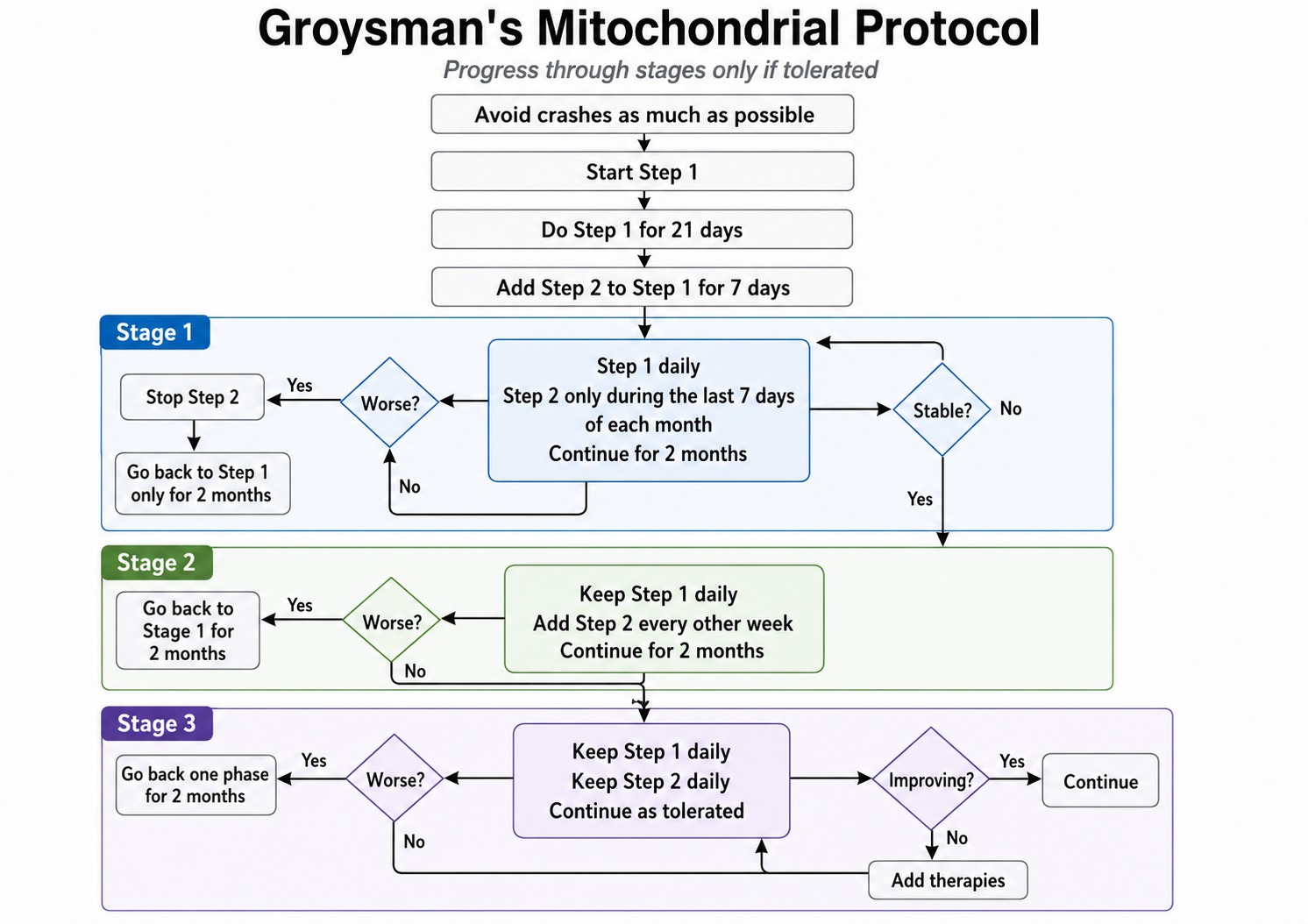
The protocol in text
Before starting: avoid crashes as far as you can. Pacing comes first, because a body in a crash cycle cannot complete a cleanup process. See our guidance on post-exertional malaise and pacing.
- Run Step 1 on its own for 21 days.
- Add Step 2 to Step 1 for 7 days.
- Stage 1, two months. Step 1 daily. Step 2 only during the last 7 days of each month.
- Stage 2, two months. Step 1 daily. Step 2 every other week.
- Stage 3. Step 1 daily. Step 2 daily, continued as tolerated.
| Stage | What you do | If symptoms worsen | If stable or improving |
|---|---|---|---|
| Stage 1 (2 months) | Step 1 daily. Step 2 during the last 7 days of each month. | Stop Step 2. Return to Step 1 only for 2 months. | Once stable, move to Stage 2. |
| Stage 2 (2 months) | Step 1 daily. Step 2 every other week. | Return to Stage 1 for 2 months. | Move to Stage 3. |
| Stage 3 | Step 1 daily. Step 2 daily, continued as tolerated. | Go back one phase for 2 months. | Continue. If progress stalls, additional therapies may be added. |
Feeling worse is never treated as a reason to push harder. It sends you back a stage.
That single rule at every decision point is what separates this from most fasting advice available online.
Dr. Groysman selects the specific supplements, doses, and interventions for Step 1 and Step 2 patient by patient, based on which organ systems your symptoms point to and what you already tolerate. They are not published here for that reason. The full framework is covered in Volume 3 of the Long COVID Handbook Series.
If you have already tried fasting and felt worse, or you want the sequence built around your case rather than guessed at, talk to Dr. Groysman. Virtual appointments are available nationwide.
Request a consultation or call (214) 390-7557
Who should not fast without medical supervision
If your body weight is already low, if your blood sugar is hard to control, if you are managing adrenal insufficiency, or if you take medication that needs food to absorb safely, fasting is not your next step without a doctor involved. The full list:
- People with low body weight or a history of eating disorders
- People with adrenal insufficiency or low cortisol
- People with uncontrolled diabetes
- Anyone with a history of hypoglycemia
- People taking medications that must be taken with food
- Pregnant or breastfeeding women
- Children and teenagers, except under a doctor’s guidance
Fasting, including intermittent fasting, should be done under the supervision of a physician. If you are managing Long COVID alongside any of the conditions above, talk to your doctor before you start.
How to start
- Start slow. Begin with a 12-hour overnight fast. Increase toward 16:8 or 18:6 only once that is comfortable.
- Stay hydrated. Water, black coffee, herbal tea, and electrolytes are all fine during the fasting window.
- Break the fast gently. Avoid large or high-sugar meals. Prioritise protein, healthy fats, and vegetables.
- Watch for symptoms. If you feel dizzy, weak, or nauseous, break the fast and eat.
In our experience, patients do best when oxidative stress and nutrient levels are stabilised before fasting is introduced, rather than the other way around.
Frequently asked questions
How long do you need to fast for autophagy?
There is not yet an established number for humans. The figures usually quoted, commonly 16 to 24 hours, come largely from animal studies, and the fasting response runs on a different timescale in rodents than in people. Autophagy is also hard to measure in a living body. Longer fasts plausibly do more cleanup than shorter ones, which makes any specific hour count a reasonable working assumption rather than a settled figure.
Is dry fasting better than water fasting?
No. We do not recommend dry fasting. Water contains no calories and does not affect the outcome of a fast, while restricting it causes dehydration and places unnecessary strain on the kidneys. For Long COVID patients who also have dysautonomia, reducing fluid intake can make symptoms considerably worse.
Can intermittent fasting help Long COVID fatigue?
It may support how the body clears and replaces damaged mitochondria, and that damage is thought to drive much of Long COVID fatigue. It is not a cure and it does not work for everyone. Some patients feel worse, which can indicate incomplete mitophagy.
Why do I feel worse after fasting?
Worsening fatigue or brain fog after a fast can be a sign of incomplete mitophagy. The cleanup starts but does not finish, and inflammation increases as a result. Low energy reserves, nutrient gaps, and high oxidative stress all make this more likely. Shorten the fast and speak to your physician rather than extending it.
Can fasting cause brain fog?
It can, and in Long COVID it often does. Two separate things may be happening. Early in a fast, some people get a temporary dip in mental clarity as the body shifts from burning glucose to burning fat. That usually settles. Fasting brain fog that arrives after the fast, or that deepens over weeks, is the more concerning pattern and points toward incomplete mitophagy rather than a normal adjustment. Shorten the fast, address nutrient status and oxidative stress, and speak to your physician.
What is the longest I should fast?
We do not recommend going beyond 48 hours, and a 48-hour fast at most once a month. Longer fasts risk nutrient deficiencies, muscle breakdown, electrolyte imbalance, and hormonal stress.
Can I drink coffee while fasting?
Yes. Black coffee, herbal tea, water, and electrolytes are all acceptable during a fasting window.
What is Groysman’s Mitochondrial Protocol?
It is a two-step, staged approach to mitochondrial repair in Long COVID. Step 1 reduces oxidative stress and rebuilds nutrient status, and runs daily. Step 2 activates mitophagy and mitochondrial biogenesis, and includes fasting. Step 2 begins as a 7-day window each month and widens through three stages, reaching daily use only if the patient tolerates each stage. At every stage, worsening symptoms send the patient back a phase rather than forward.
Should you fast before or after addressing oxidative stress?
After. Cleanup requires energy and nutrients to complete. Fasting while oxidative stress is high and nutrient status is poor makes incomplete mitophagy more likely, which increases inflammation instead of reducing it. Step 1 comes first for that reason.
How often should mitophagy be activated?
That depends on where you are in the protocol. Step 2 starts as a single 7-day window each month, moves to every other week, and can become daily once a patient has held stable through the earlier stages. The frequency is earned rather than chosen. Beginning at daily activation while still depleted is what tends to produce incomplete mitophagy.
Talk to us about your recovery
Fasting is one part of a wider approach to mitochondrial repair, and it works best when it is sequenced correctly against your oxidative stress and nutrient status. Virtual appointments are available nationwide, and Dr. Groysman sees patients in person in Plano, Texas.
The mechanisms on this page are covered in full in Volume 3 of the Long COVID Handbook Series: Mitochondrial Dysfunction. To build a version of the protocol around your own case, talk to us.
Request a consultation or call (214) 390-7557
References
- Fazeli PK, Steinhauser ML. A Critical Assessment of Fasting to Promote Metabolic Health and Longevity. Endocrine Reviews. 2025;46(6):856-876. doi:10.1210/endrev/bnaf021
- Molnar T, Lehoczki A, Fekete M, et al. Mitochondrial dysfunction in long COVID: mechanisms, consequences, and potential therapeutic approaches. GeroScience. 2024. doi:10.1007/s11357-024-01165-5 (PMID 38668888)
- Bunker T, et al. Intermittent fasting and a no-sugar diet for Long COVID symptoms: a randomized crossover trial. Scientific Reports. 2025. doi:10.1038/s41598-025-07461-0
- Refeeding Syndrome. StatPearls, NCBI Bookshelf. NBK564513
- Jimenez-Loygorri JI, et al. Mitophagy curtails cytosolic mtDNA-dependent activation of cGAS/STING inflammation during aging. Nature Communications. 2024;15(1):830. doi:10.1038/s41467-024-45044-1 (PMID 38280852)
- Vernino S, Stewart JM, Raj SR, et al. Postural orthostatic tachycardia syndrome (POTS): State of the science and clinical care from a 2019 National Institutes of Health Expert Consensus Meeting, Part 1. Autonomic Neuroscience. 2021;235:102828.
This page is for educational purposes and is not medical advice. It does not establish a doctor-patient relationship and does not replace consultation with a qualified physician. Individual results vary. Do not start, stop, or change any treatment, medication, or fasting regimen based on this page. See our full medical disclaimer.