
If your heart races the moment you stand, if you have been told your labs are normal while your body clearly is not, you are not imagining it. POTS is real, it is measurable, and after COVID it can traces back to: a sympathetic nervous system stuck in the “on” position. A stellate ganglion block is one of the few treatments aimed at that root, not just the racing heart it causes.
A stellate ganglion block, or SGB, is a small injection of local anesthetic into a cluster of nerves in the neck. For POTS, the goal is to quiet an overactive sympathetic nervous system so heart rate, blood pressure and blood flow can settle back toward normal when you change position. It treats the dysregulation behind POTS, not the symptom alone.
What is POTS , and why it shows up after COVID
POTS, postural orthostatic tachycardia syndrome, is an excessive jump in heart rate when you move from lying or sitting to standing, usually with dizziness, lightheadedness, palpitations and brain fog. The cardinal feature is the tachycardia on standing. A tilt table test, tracking heart rate and blood pressure as your position changes, usually confirms it.
POTS is one of the most common forms of dysautonomia, and Long COVID patients can develop it. The pattern points to a post-viral autonomic neuropathy including the virus, or the immune response to it, disrupts the nerves meant to keep your circulation steady when gravity pulls blood toward your legs. Your body compensates the only way it can, by flooring the accelerator. The heart races to keep blood reaching your brain.
The fast heartbeat is not the issue, it’s the body’s response to a nervous system knocked off balance.
How a stellate ganglion block targets POTS
Think of your autonomic nervous system as a car with two pedals. The sympathetic nervous system is the gas pedal, the fight-or-flight side, speeding the heart and tightening vessels. The parasympathetic nervous system is the brake, the rest-and-heal side. In POTS after COVID, the gas pedal is stuck in the down position. The stellate ganglion block lifts the foot off it.
The stellate ganglion is a star-shaped cluster of sympathetic nerves on the front of the spine in your neck. It relays many of those gas-pedal signals to your head, heart and chest. By placing a local anesthetic right at this cluster, the block interrupts the overactive sympathetic output. While the sympathetic side is quieted, the parasympathetic brake comes up, because the two sit on opposite ends of a see-saw. When sympathetic tone falls, vagus nerve tone rises.
The anesthetic itself is gone within hours. The reset is what lingers. While the block is active, regional blood flow across the brain, head, neck and chest shifts, and in many people the calmer balance holds well after the medication wears off. Rather than healing a nerve, the block corrects an abnormal feedback loop in a stuck system.
What the evidence shows for SGB and post-COVID autonomic symptoms
The published evidence is early but consistent. The most cited study is a 2023 retrospective cohort in Cureus (Pearson et al., 41 patients), reporting improvement in at least some Long COVID symptoms for 86% of participants. Several of the improved symptoms overlap directly with POTS, including tachycardia and palpitations (relief in 78% of those reporting them) and dizziness (77% of those reporting it).
To be clear about who these numbers belong to, the 86% table comes from the published Pearson study, not from a separate dataset of Dr. Groysman’s own patients.
An earlier case series by Liu and Duricka (Journal of Neuroimmunology, 2022) first described the effect, though in only two patients. A 2026 systematic review in Current Pain and Headache Reports pulled together seven studies and found symptom improvement across all of them, and the authors recommended SGB particularly for people with prominent autonomic dysfunction, exactly the POTS picture.
There is a fair counterpoint, and you deserve to hear it. A 2025 cohort study from Brigham and Women’s Hospital (52 patients) found while 56% saw some improvement, only about 14% had lasting relief, and most patients needed roughly three injections. None of these studies had a control group. This is a young evidence base. It is promising, not proven, and any honest clinic should tell you so.
What Dr. Groysman can add is experience. Across thousands of stellate ganglion blocks over his career, he has not witnessed the serious complications showing up in the older closed-claim literature. This is a track record, not a cure, and POTS coming from something other than dysautonomia may not respond as a single treatment option.
What to expect during the procedure
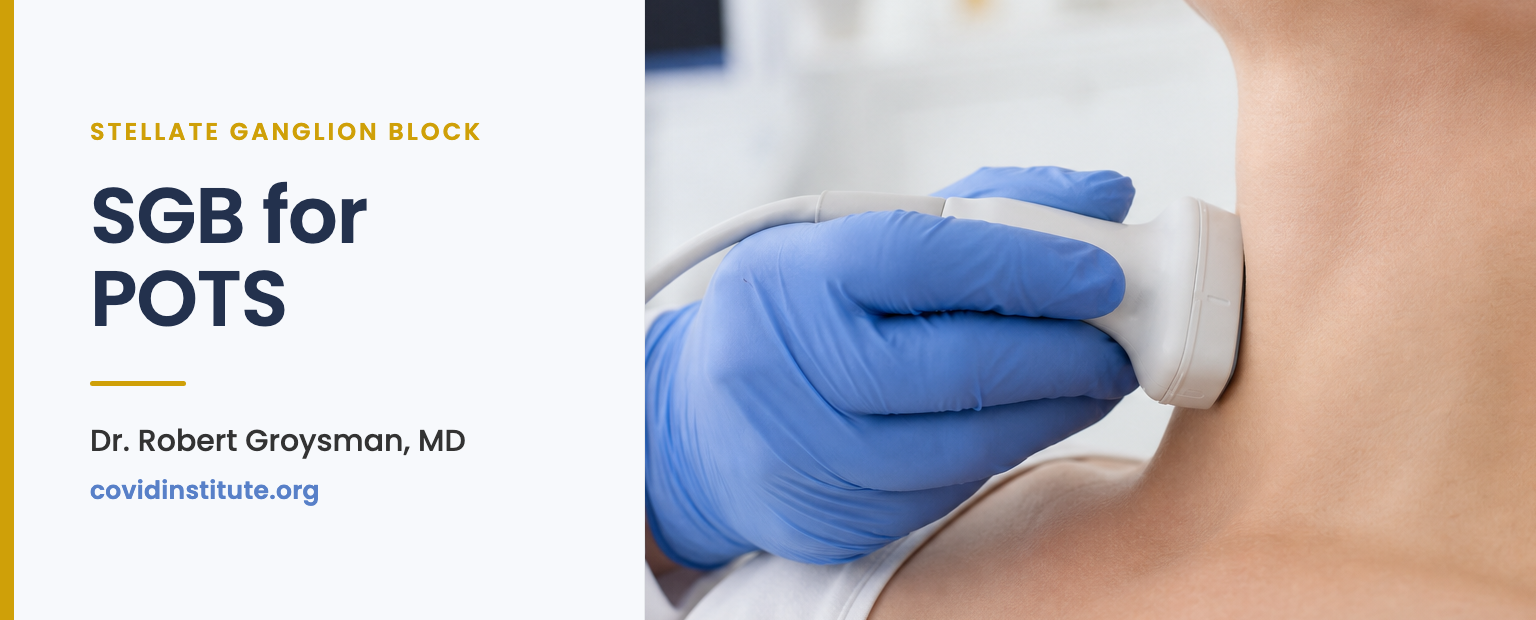
An SGB is an outpatient injection, done awake, usually finished in under ten minutes. Expect the pressure of the ultrasound probe against your neck, a brief pinch, then a few seconds of mild burning while the anesthetic spreads. The area numbs quickly. Most people drive themselves home and get back to their normal day.
Dr. Groysman’s technique is not the standard single-level block used for pain. He uses live ultrasound guidance so arteries, veins, the thyroid and nerves stay visible and avoidable, and he blocks at two levels, C6 and C4, rather than one. The higher level reaches the superior cervical ganglion, the sympathetic road to the brain, an addition Dr. Eugene Lipov reported which could help improve results.
Who is a good candidate
SGB helps POTS when the POTS is driven by autonomic dysregulation, which is the common post-COVID pattern. The strongest candidate is the hyperadrenergic picture, the patient whose system is clearly running too hot with a pounding heart on standing, tremor, surges of anxiety, a sense of being wired and unable to power down. This represents a sympathetic system in overdrive, and the sympathetic system is exactly what the block quiets. POTS driven by low blood volume, or bundled with hypermobility, may still improve, but the response can be less predictable.
It is not a fit for everyone.
Long COVID has more than one driver, and gut dysbiosis or mitochondrial dysfunction can produce overlapping symptoms a sympathetic block might not touch. When an SGB does not work, the most common reason is the symptoms were not coming from dysautonomia.
This is why the first step is a proper evaluation, not the needle. Dr. Groysman uses a four-step process to map which Long COVID mechanisms are driving your case before he recommends a treatment. If dysautonomia is the driver, SGB can be a strong option. If something else is driving symptoms, you deserve to know before booking a procedure.
Results can also fade. Because the body likes its old equilibrium, a stressful stretch, another infection or surgery can pull the sympathetic system back toward where it was before the rest. This is why some people need more than one SGB, and some pair the block with vagus nerve stimulation and other support to help maintain balance.
How SGB fits with standard POTS care
A stellate ganglion block is not a replacement for the basics. Increased fluid and salt to expand blood volume, compression to reduce blood pooling in the legs, a graded exercise program respecting post-exertional malaise and medications like beta-blockers, fludrocortisone or midodrine all still have a place. You can read more about the foundational approach in what is dysautonomia and the Levine protocol for POTS.
The difference is target. Those tools manage the symptom or support circulation. The block goes after the dysregulation generating the symptom. For the right patient, used together, they do more than either does alone. For the bigger picture of how POTS fits inside post-COVID autonomic dysfunction, see what is dysautonomia.
Frequently asked questions
Does a stellate ganglion block cure POTS?
No. It does not cure POTS or heal a nerve. It interrupts an overactive sympathetic nervous system so your autonomic balance can reset. For many people that reset improves standing tolerance, palpitations and brain fog, but response varies and some people need a repeat block.
How fast will I know if it helped my POTS?
Some effects, especially anxiety and the racing feeling, can ease within minutes to hours. Other symptoms often settle over the next day or two. If autonomic dysregulation was the driver, most people have a sense of the response quickly.
Is the procedure safe?
SGB carries known risks, but they are uncommon, and ultrasound guidance keeps the important structures in view. In thousands of procedures over his career, Dr. Groysman has not seen those serious complications in his own clinic. The temporary Horner’s syndrome afterward is expected and harmless.
My heart rate is still high right after the injection. Did it fail?
Not necessarily. Heart rate and blood pressure can tick up for the first 30 to 60 minutes after a block. The signs that the block landed are the temporary Horner’s syndrome on that side, not your standing heart rate that same hour. The autonomic changes that matter for POTS usually settle in over the following day or two.
How many injections will I need?
There is no fixed number. Some people get lasting benefit from one. In published series, patients often had around three over time, and Dr. Groysman usually begins on the right side; in his experience that side responds first for most patients. When the plan calls for it, both sides can be treated safely in one visit. Whether you need a repeat depends on how your symptoms respond and hold.
Do I need to stop any medications first?
Tell the clinic if you take blood thinners or platelet blockers such as Eliquis or Coumadin, since those may need to be paused a few days before. There is otherwise little to do beforehand, and you do not need to fast. You generally do not stop your POTS medications to have the procedure.
Take the first step
POTS after COVID is not in your head, and the racing heart is not the whole story. If autonomic dysregulation is driving your symptoms, a stellate ganglion block may help your body find its balance again. The way to know is a proper evaluation.
Request a consultation with Dr. Groysman
Learn more about the procedure on the main stellate ganglion block page, or see what a successful block looks like.